|
Operation Marquis
Peace Keeping Mission in Cambodia - 1992
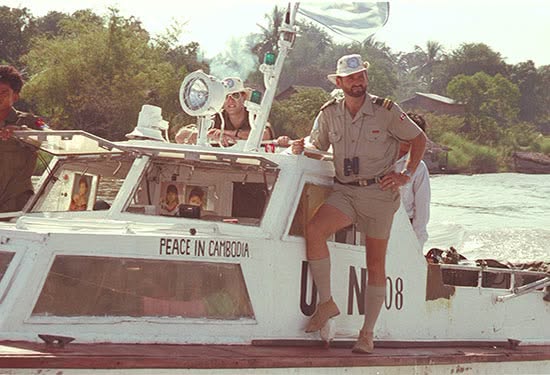
Gerry White, a Canadian naval officer serving in Cambodia in 1992, standing aboard a UN patrol craft marked “PEACE IN CAMBODIA.” White was part of Canada’s contribution to the United Nations Transitional Authority in Cambodia, or UNTAC, during Operation MARQUIS.
Canadian Sailors on the Mekong: The RCN’s Little Known Peacekeeping Mission in Cambodia
At the time, the navy was officially known as Canadian Forces Maritime Command, although today we would recognize these sailors as part of the Royal Canadian Navy’s peacekeeping history.
Canada deployed approximately 240 personnel to Cambodia at any one time, and among them was a 30 person Canadian naval contingent. These sailors did not arrive aboard a Canadian warship. Instead, they joined UNTAC’s Maritime Component and operated from Cambodian naval bases, headquarters and patrol vessels throughout the country’s extensive river and coastal system.
Their operating area included the Mekong River, the Tonlé Sap, Cambodia’s network of rivers and tributaries, and portions of the Gulf of Thailand.
For sailors accustomed to operating frigates and destroyers in the Atlantic and Pacific, Cambodia presented an entirely different type of naval operation.
The country’s rivers were major transportation routes. Decades of war had left roads destroyed, bridges damaged and large areas contaminated by mines. During the rainy season many land routes became almost unusable. The Mekong and its tributaries therefore became essential highways for commerce, military movement and humanitarian assistance.
Canadian sailors consequently found themselves conducting something much closer to traditional riverine naval operations.
They patrolled aboard Cambodian and UN vessels, entered tributaries in small boats, monitored ceasefire violations, investigated suspicious activity, tracked the movement of weapons and ammunition, watched for smugglers and pirates, and gathered information from communities along the waterways.
Patrols could involve travelling up narrow rivers to isolated settlements and meeting fishermen, village leaders and representatives of Cambodia’s various armed factions. Information collected by naval observers was passed back through the UN command structure and helped UNTAC understand what was happening well beyond the major population centres.
There was also an important technical side to the Canadian naval contribution.
Much of Cambodia’s remaining naval fleet was in very poor condition after years of war and neglect. Canadian Hull Technicians, Marine Engineering Technicians, communications specialists, supply personnel and experienced small-boat sailors helped inspect and repair vessels and assisted Cambodian crews in returning boats to operational condition.
Some vessels suffered from serious corrosion, broken navigation equipment, unreliable firefighting systems and questionable lifesaving equipment. In some cases ammunition, mines and even missiles were being stored under conditions that would make any Canadian naval technician uncomfortable.
Initially it had been expected that UN naval personnel might actually crew some Cambodian vessels themselves. Instead, Cambodian sailors generally continued operating their ships while Canadian and other UN naval observers embarked to supervise patrols, provide advice and help coordinate operations.
The work could be dangerous. Smuggling was widespread. River banditry was a genuine problem. Armed groups continued operating despite the peace agreement, and unidentified vessels moving at night risked being fired upon. Maritime patrols therefore normally operated during daylight hours, and some operations eventually required armed UN troops to protect naval observers guarding seized contraband.
Yet the mission was about far more than enforcing the peace. That is where Gerry White’s story gives this photograph particular meaning.
White
served as a naval operations officer and element commander at Ream
Naval Base in southern Cambodia. His duties included patrolling the
Mekong, Tonlé Sap waterways and Cambodian coastal areas aboard
vessels such as the Russian-built patrol boat seen in this photograph.
They brought food, medicine and toys to children living along the waterways. Eventually, hundreds of boxes of toys were reportedly sent from Canada. White would sometimes play his harmonica as their patrol boat approached a village, helping encourage children to come out and meet the Canadian sailors.
The Canadians also tried to appear less threatening around children who had grown up surrounded by soldiers and weapons. When circumstances permitted, they avoided combat clothing and weapons during those encounters.
It was a small gesture, but one that captured the wider purpose of the mission.
The Canadian naval contingent in Cambodia demonstrated something that is sometimes forgotten when discussing the RCN: naval service is not limited to operating large warships at sea.
Sailors can contribute wherever maritime knowledge, engineering skill, communications expertise, navigation, leadership and small-boat experience are required.
In Cambodia, Canadian sailors operated hundreds of kilometres from anything resembling a traditional Canadian naval deployment. They repaired ships, trained crews, patrolled rivers, confronted smugglers, monitored ceasefires, gathered intelligence and brought humanitarian assistance to isolated communities.
No Canadian frigate sailed up the Mekong.
But the Canadian Navy was there.
And sailors such as Gerry White were part of a remarkable and often overlooked chapter of Canadian naval history.
On National Peacekeepers’ Day, their service deserves to be remembered alongside that of every Canadian who wore the blue beret in the cause of international peace and security.
To Gerry White and to all Canadian sailors, soldiers and aviators who served on peacekeeping operations around the world: thank you for your service. (Source: Facebook post: Royal Canadian Navy Today and Yesterday 10 Aug 2026)
|