|
In memory of those who have Crossed the Bar
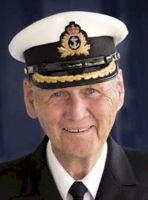
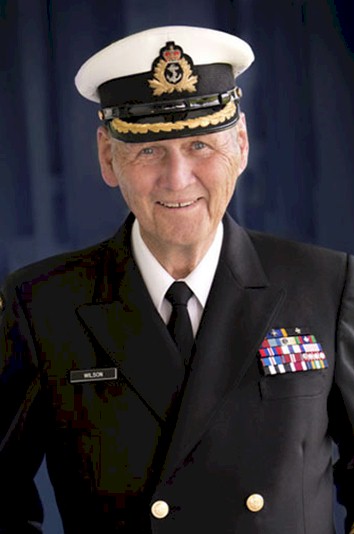
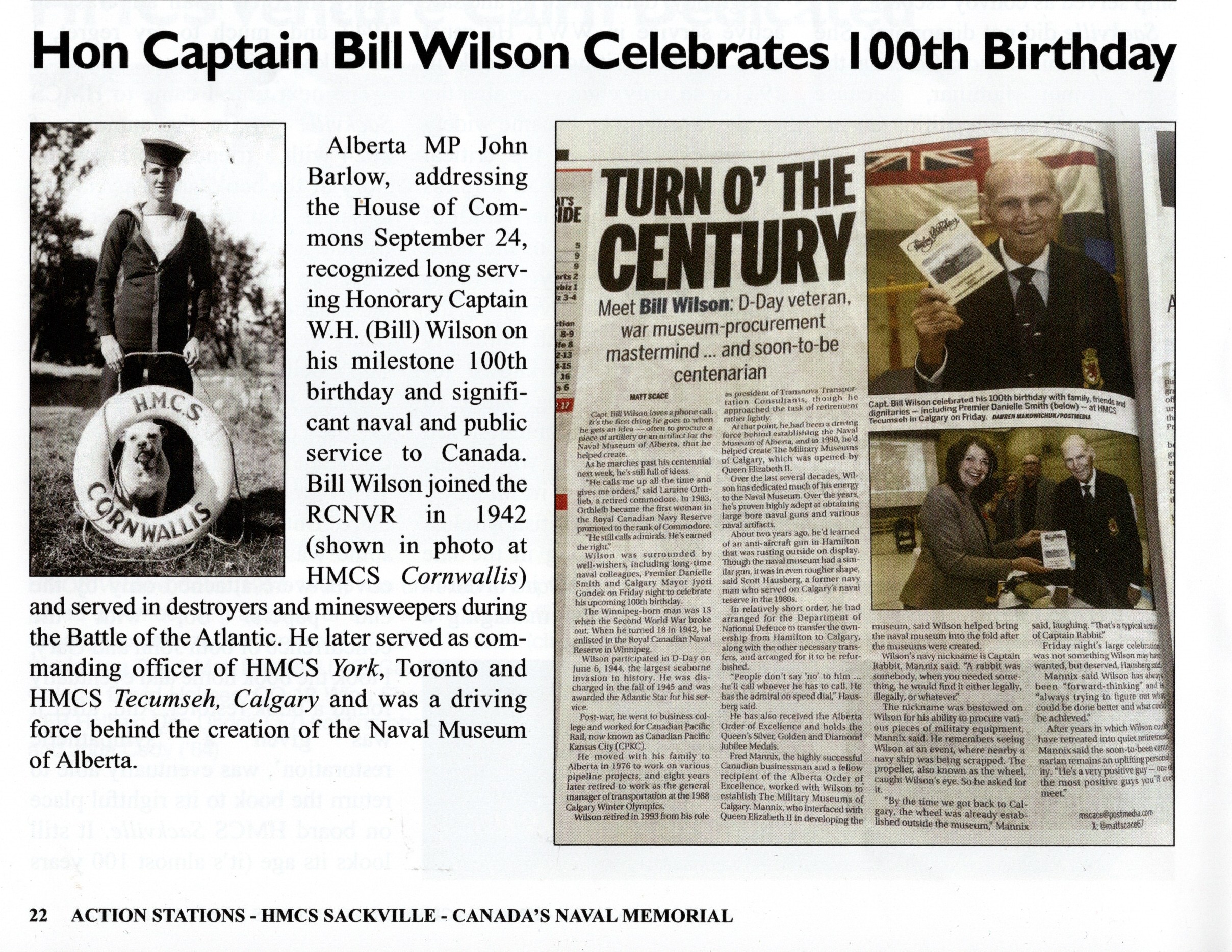
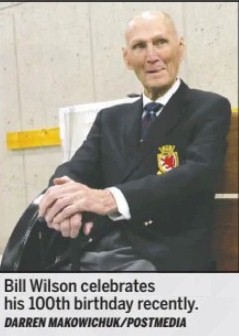
WILSON, William Hargen - It is with profound sadness that the Calgary naval community announces the passing of Captain (Navy) (Retired) William H. “Captain Bill” Wilson on July 27, 2026 at the age of 101.
Born in Winnipeg, Manitoba, on November 5, 1924, Bill devoted more than eight decades to serving Canada, both in uniform and through extraordinary volunteer leadership. He enlisted in the Royal Canadian Naval Volunteer Reserve during the Second World War, serving aboard HMCS Ottawa and participating in the Battle of the Atlantic and the D-Day landings. He later continued his naval career in the Naval Reserve, retiring with the rank of Captain after 52 years of distinguished service.
Following a successful career with Canadian Pacific and leadership roles with the 1988 Calgary Winter Olympic Organizing Committee, Bill became the driving force behind the Naval Museum of Alberta and helped realize the vision of The Military Museums in Calgary. His unwavering commitment preserved Canada’s naval and military heritage for future generations.
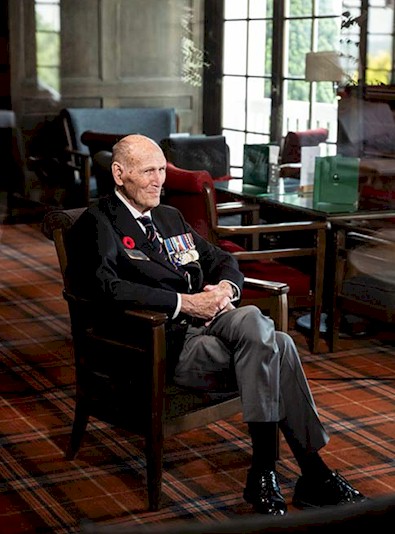
Known affectionately as “Captain Bill,” he inspired countless people through his optimism, generosity, and determination. He was appointed an Officer of the Order of Military Merit, received the Alberta Order of Excellence, and earned numerous national honours in recognition of his remarkable service.
Bill will be remembered as a devoted family man, mentor, patriot, and friend whose legacy of leadership, service, and community spirit will continue to inspire generations of Canadians.
Remembrance details will be promulgated once known. (Organization of Military Museums of Canada Facebook post 28 Jul 2026)
As the sun rose on the morning of 6 June 1944-D-Day-seaman gunner Bill Wilson was standing on the deck of HMCS Ottawa. While normally below deck in hammocks, Bill and anyone who could were watching the scene below them unfold from the deck.
"It was cold and I went through half a pack of cigarettes in a hurry," recalled Wilson as he and the crew eagerly waited.
"I knew things were happening but I couldn't see anything," remembered Wilson as the day started. "We were on the west flank of Utah Beach. We could hear rumbles, when battleships fire they make a lot of noise." At the break of dawn, the clamour became more intense as the invasion ramped up. The sun revealed a scene like no other. A sky chock-full of planes and barrage balloons - below them, landing craft upon landing craft headed directly towards the smoking beach.
"It was quite a sight, the largest invasion in history," remarked Wilson.
William Hargen Wilson was born on 5 November 1924 in Winnipeg. In September 1939, he joined the Sea Cadets and in December 1942, he joined the Royal Canadian Naval Volunteer Reserve. Only 18 when he first saw service, his years in Sea Cadets gave him the advantage of being more knowledgeable than most recruits.
Wilson spent his first year training and guarding HMC bases. By 1944 he was escorting convoys. D-Day marked a big change for him and his crew. It was time to go on the offensive. "I think all of us felt the same, how well were we going to perform individually and collectively," recalls Wilson. "And of course, in the Navy, you've got to work as a team. You all end up serving together. We depend on each other. You fight as one. You depend on the guy standing next to you, the guy who is above and the one below you. You know that everyone is going to do their job. That's what you're trained to do.
From day one from an ordinary seaman up to the commanding officer.
"It is essential that you work as a team or you all end up swimming together."
The months following D-Day were eventful for Wilson and crew. In fact, they spent the whole month following D-Day at sea. He doesn't remember a day going by that didn't see them drop at least some depth charges. HMCS Ottawa and Escort Group 11 sunk three U-boats and rescued German survivors of another U-boat sunk by Coastal Command aircraft. They also took fire from a German coastal battery. "That was scary," remarked Williams about his ship nearly being hit.
Even the return trip home to Canada was disquieting, when a storm battered their ship and a crew member of an accompanying destroyer was lost overboard in rough waters.
Once back in Canada, Wilson happily recalls getting a care package from his parents containing cake and homemade raisin tarts. The hearty food was warmly received, as Wilson had grown tired of rations, in particular Spam and ketchup. "Lots of Spam," recalls Wilson. "We had boiled Spam, fried Spam, chopped Spam… and lots of tomato ketchup. I have not eaten a can of Spam since 1945."
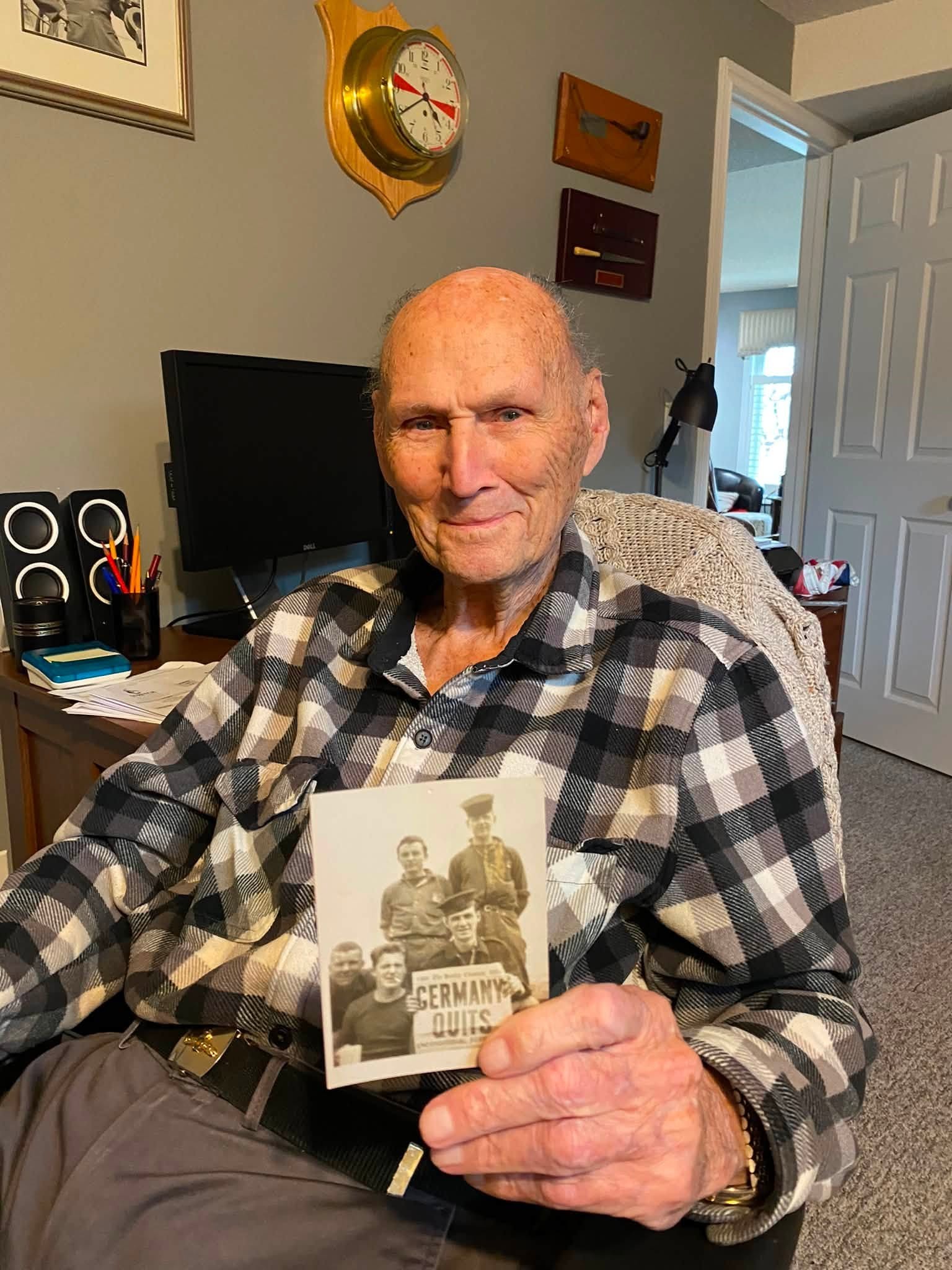
Known during the war as Tug and later as Captain Bill, Wilson was discharged from active service in the fall of 1945; however, he joined the naval reserve that same year and rose through the ranks over the ensuing years. He retired from active service in 1979, having reached the rank of Captain in the Royal Canadian Navy. He now lives in High River, Alberta and at 100, his house still remains free of tomato ketchup.
"The
thought occurred to me that maybe he was looking at an old man from Canada who
arrived at this exact spot some 75 years ago to help free his country."
Wilson and the young boy who sheltered him from the rain developed a connection that transcended the language barrier they faced. "The thought occurred to me that maybe he was looking at an old man from Canada who arrived at this exact spot some 75 years ago to help free his country," recounted Wilson. "I immediately had a lump in my throat. It was, all-in-all, quite an unexpected emotional experience."
After returning to Canada, Wilson wanted to try and reach out to the boy to thank him. With some investigation, using a photo from the event and a little luck, the boy was identified as 10-year-old Florent Geffrey from Normandy. Wilson sent Geffrey a package that included a photo of the ship Wilson served on, HMCS Ottawa. Geffrey's show of kindness and respect had touched Wilson.
"I lost two close friends who participated in the landing in June 1944," remembered Wilson. "Nineteen year old Joe Shack, in my high school graduating class who was a Rifleman in the Royal Winnipeg Rifles, and Jacky Wheeler who lived four houses away from me and was a Trooper in the Fort Garry Horse (tanks) aged 20, lost their lives within weeks of landing in France. When I visited their graves 25 years ago, I wondered if it was really worth it. Now, having met young Master Florent Geffrey, I feel that maybe their sacrifices were after all, not in vain."
In June 2024,
Wilson will be travelling back to France with the Government of Canada
delegation to commemorate the 80th anniversary of D-Day and the Battle of
Normandy. Geffrey is determined to meet his Canadian friend again. Now 15, he
is the same age as Wilson was when he first joined the Sea Cadets.
Appointed A/SLt, RCN(R) 1949 // Appointed SLt, RCN(R) 1958 // Appointed Lt, RCN(R) 1960 // Appointed A/LCdr, RCN(R) 1963 // Appointed LCdr, RCN(R) 1963 // Appointed Commander, C.A.F. (NR) 1975 // Appointed Honourary Capt (N), C.A.F. (NR) 1975
Ships served in (Wartime Service):
Post Wartime Service:
Click on the article to view a larger version
After friend was killed by U-boat, Calgarian joined crew of ship chasing them The Calgary Herald 09 Nov 2024 by Brian Kaufmann After his best friend perished in a U-boat attack on a Canadian destroyer, Bill Wilson knew he wanted to fight aboard the lost ship's namesake successor. In September 1942, HMCS Ottawa was struck by two torpedoes in the Atlantic Ocean while escorting merchant ships on their way to the U.K. The second torpedo launched by German submarine U-91 broke the stricken vessel in half. Among the 134 sailors who died in the attack was 20-year-old Ordinary Seaman Cliff Rasmussen. “His ship was sunk off Newfoundland, he was my pal, on his first trip,” said Albertan Wilson, who, like Rasmussen had been a Winnipeg sea cadet looking to do his part in the war effort. When the sunken vessel's successor ship was docked in Halifax in March 1944, a 19-year-old Wilson, who'd been pulling shore duty with a rifle slung over his shoulder, said he was asked which ship he'd like to embark on. “Without any hesitation, I said the Ottawa 2. We sailed the next morning,” the still-rangy naval veteran said recently, a day after marking his 100th birthday. Wilson said he wasn't out to avenge the loss of HMCS Ottawa or his friend. “I just wanted to go to sea,” he said. But as it turned out, Wilson would find himself hunting the very same fleet of U-boats that had taken the life of his buddy. By the time he'd joined its crew, HMCS Ottawa 2 had escorted multiple convoys across the Atlantic over the previous year, delivering 540 cargo ships without a loss to German torpedoes. They'd been effective in chasing off U-boats before they could sink the merchant vessels they shepherded. Now his British-built vessel would be part of a five-destroyer submarine-killing team preying on what had been the scourge of Allied shipping but for nearly the past year, had been more often the hunted as the fortunes of war shifted. After training in the north of Scotland, it would ultimately have a hand in destroying three U-boats, the first sunk in an effort to protect the build-up from the D-day landings in June 1944. Wilson
said he'd been initially designated as a gunner but gravitated toward being
a signaller — a crucial role in the success of multiple-ship submarine
hunter-killer teams. Those skills were put to work in coordinating an attack on a suspected U-boat detected off the port of Portsmouth in the shallow English Channel. “We ran over the thing with echo sounders, we weren't sure if it was really a U-boat because there were so many wrecks in the Channel,” said Wilson, whose ship employed depth charges and a hedgehog mortar system that would fire off two dozen bombs in a single stroke. “But we attacked and kept on attacking and oil came up, then papers and clothing but no bodies.” Some of those papers were pages from the log book of U-678's commander, which were kept as souvenirs by the Ottawa 2's crew, said Wilson. Canadian sailors, he said, gained a reputation for learning to use naval technology and tactics quickly. “We really worked as a team (between ships), we were good,” said Wilson. “Once we found a U-boat, it was game over (for them)." With information gained from breaking German operational codes, the Ottawa 2's hunter-killer team could zero in on the submarines, an advantage they used in sinking two more of the U-boats in a span of three days in August 1944, he said. “We also had a good idea from the French underground of how many were coming out from their pens and when,” said Wilson. The hunting team, he said, sank one U-boat in the Bay of Biscay heading to its heavily-reinforced pen in the French port of Lorient — the other while it was leaving its refuge. “We sank those ships with hedgehogs,” said Wilson, of U-621 and U-984, adding there were no survivors from any of the three U-boats destroyed by the team. “One hundred and fifty German sailors are still down there.” But probably the most impressive image among Wilson's wartime memories was the sight of the mighty D-day armada of 7,000 ships and landing craft that delivered 133,000 Allied troops to the Normandy beaches on June 6, 1944. “You could almost walk across the channel on top of the ships, there were lines and lines of them ... it was awe-inspiring,” he said. Wilson would keep his hand in maritime military affairs in the following decades, eventually spearheading the creation of the Naval Museum of Alberta, which would be incorporated into The Military Museums. While he expresses pride in that work, the man who's become an icon in the prairie naval community said he's not optimistic in how Canada's wartime efforts are remembered. “Nobody gives a damn ... people wear poppies now but it's a one-day affair,” said Wilson. “We work to educate about what Canada did in the war effort, but they don't teach that in Canadian history in schools.”
|